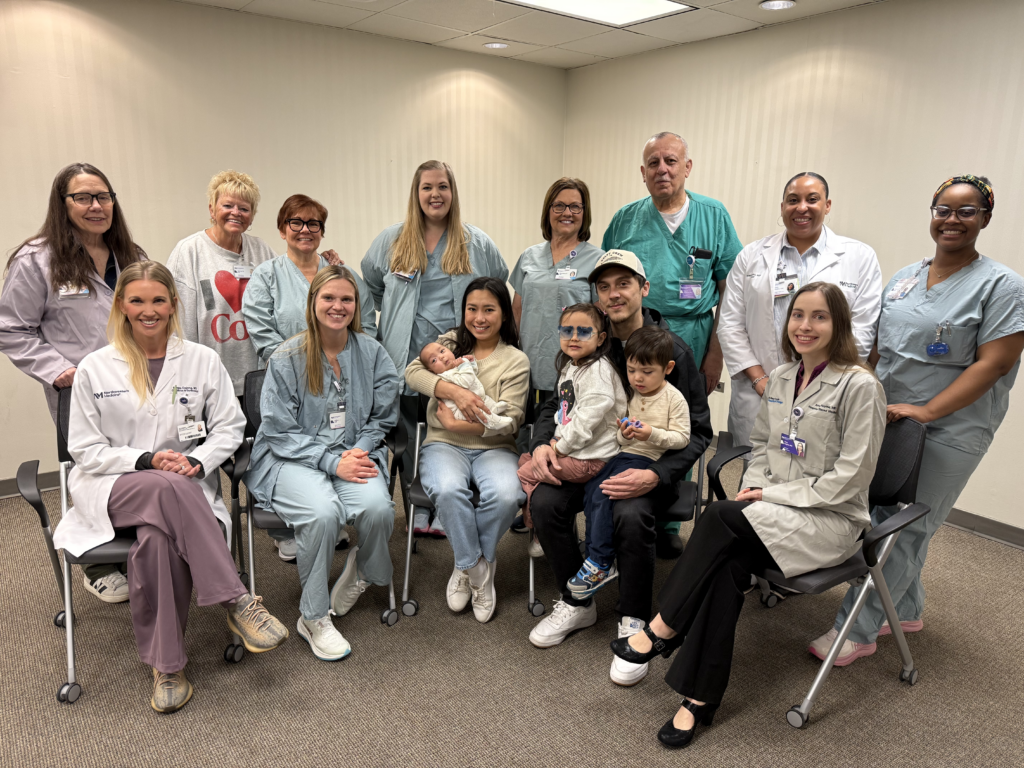
Rapid Maternal Code Response Helps Doctors Save Mother and Baby at Northwestern Medicine Palos Hospital
When Ariana Del Valle began bleeding heavily at home on the morning of January 11, she knew something was terribly wrong. Twenty-nine weeks pregnant with her third child and diagnosed earlier in her pregnancy with placenta previa, Del Valle had been warned that severe bleeding could happen suddenly. Still, nothing could have prepared her for how quickly her condition deteriorated.
“The moment I sat up, I almost passed out. My blood pressure dropped, I felt hot, sick and nauseous — like my body was starting to shut down,” Del Valle recalled. “I was so sick and worried about my baby.”
Her husband called an ambulance and paramedics alertedNorthwestern Medicine Palos Hospital en route triggering a Maternal Code, a specialized emergency response designed for critically ill pregnant or postpartum patients. By the time Del Valle arrived by ambulance, a multidisciplinary team was waiting.
“This is exactly why we train,” said Alexander Lin, MD, obstetrician-gynecologist at Northwestern Medicine Palos Hospital. “When something rare and catastrophic happens, you don’t have time to figure things out in the moment. Because we had practiced, everyone knew their role and we were able to act immediately for the best possible outcome.”
Preparing to Save Two Lives
When the ambulance carrying Del Valle arrived at Palos Hospital, she said the amount of people who jumped in to help was unbelievable.
“Within minutes, I was surrounded by a big team of people,” she said. “Everybody had a job. Everybody was getting it done. I was terrified, but everything was moving so fast.”
Del Valle was actively hemorrhaging due to placenta previa, a rare and life-threatening pregnancy complication in which the placenta blocks or covers the cervix.
Within eight minutes of arrival, she was taken to the operating room for an emergency cesarean section and placed under anesthesia due to the severity of her condition. Her son, Levi, was delivered at just 29 weeks and two days, weighing 3 pounds, 6 ounces.
“Everything escalated so quickly that by the time my husband got to the hospital, our baby was already born,” Del Valle said.
Both mother and baby survived, an outcome clinicians say depended on rapid coordination, preparation and repeated training.
A Different Kind of Emergency Response
Unlike a standard adult code blue, a Maternal Code activates a customized response team trained specifically for emergencies involving pregnant or newly post-partum women. Obstetricians, emergency medicine physicians, anesthesiology, intensive care specialists and neonatology assemble at the bedside, all focused on stabilizing both mother and baby. While Maternal Code teams are increasingly common in hospitals that provide maternity care, the practice is not universal.
“Obstetric emergencies are different,” Dr. Lin said. “You’re caring for two patients at once, and things can change in seconds. The Maternal Code brings the right expertise to the bedside without delay.”
Northwestern Medicine Palos Hospital implemented the Maternal Code program to strengthen readiness for high-risk, low-frequency events. Teams regularly participate in drills and simulations involving labor and delivery, the emergency department, the ICU and neonatology. Recently, the hospital added a high-fidelity simulation mannequin to further enhance training realism.
“All of that preparation paid off,” Dr. Lin said. “This was the first time we used the Maternal Code in such a truly life-threatening situation.”
A Long Road and Two Lives Saved
After birth, Levi was stabilized and transferred to Ann & Robert H. Lurie Children’s Hospital of Chicago for specialized neonatal care, where he spent 85 days in the Neonatal Intensive Care Unit (NICU).
Del Valle remained hospitalized for two days before beginning her own recovery. “I was grateful he was alive, but it was heartbreaking to see him that way,” she said. “It’s still a lot to process.”
Del Valle and her husband, Brian, were able to bring Levi home from the NICU on April 6, 2026. Levi is now thriving, alongside his two siblings, Lucia, age 4, and Noah, age 3.
“I feel very blessed that my son is well, I’m well, and we’re alive,” Del Valle said. “I don’t know why this happened to me, but I’ve learned so much from it. I’m focusing on the positives.”
She credits the Palos team, and their readiness, with saving her life.
“Dr. Lin told me if I had waited another 30 minutes, we would not be here,” Del Valle said. “I didn’t even realize how many people it takes to save one life — let alone two. They had blood ready, surgeons ready, everything prepared in case of a turn of events.”
Community Care, System-Level Expertise
While Northwestern Medicine Palos Hospital is a community hospital, it offers 24/7 in-house neonatology and follows the same evidence-based protocols used across the Northwestern Medicine health system.
“Patients receive the same standards of care they would at an academic medical center,” Dr. Lin said. “That preparation can be lifesaving, especially when emergencies unfold in minutes.”
As Mother’s Day approaches, Del Valle hopes her story emphasizes the importance of maternal emergency preparedness. “I wish I could thank every single person who helped me,” she said. “I can’t thank them enough.”